Housebroken: Three Novellas by Yael Hedaya
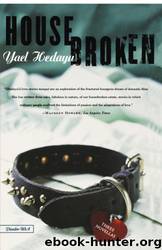
Author:Yael Hedaya [Hedaya, Yael]
Language: eng
Format: epub
Publisher: Henry Holt and Co.
Published: 0101-01-01T00:00:00+00:00
MATTI
On May fifth, 1990, which was a lovely spring day, a man came in with his wife who complained that he was suffering from headaches. “Terrible ones,” she said and shook her head, “terrible headaches,” as if they were her own, and then she squeezed the hand of the tall shy man who within minutes became our patient.
We let her describe the symptoms, enriched by metaphors full of distress and imagination, and when she finished, leaning toward us and whispering, “My husband’s not the same person he used to be,” as if he weren’t there, we nodded and asked: “How long has this been going on?” and she said: “About three months.”
“Since February?”
“Yes, February,” she said.
“Pain since February,” we wrote down, and the woman—who rose from her chair to glance at the brand-new medical chart, which might have contained something that cheered her up, with its look of importance, its possibilities, and in the creative freedom the patient was about to ruin for us all—said: “Yes, February. He had a bad case of the flu and then it started,” and we wrote: “After a flu, the patient began to complain of pain.” “A bad flu,” she emphasized, so we wrote: “After a bad case of influenza the patient began to complain of pains.” “Terrible pains!” she insisted and pointed at our pen, so we wrote down “terrible,” too, and the woman put her hand back in her lap and nodded approvingly, as if we had jointly finished composing the first, indifferent sentence of a fairy tale, immediately after which the horrors would begin.
She quickly picked up the style and began dictating the case history to us, adding to “terrible”—“sharp,” “blinding,” “paralyzing,” “unbearable,” “monstrous,” “inhuman,” “indescribable”—and when she felt that the description of the pain was overshadowing the pain itself, she looked at her husband who was staring at the carpet scratching his head, asking him with her eyes to contribute something, just one word to sum it all up, but the man mumbled: “No.”
“No?” she asked.
“Not three months.”
“Two months, then?” she scolded him. “What difference does it make, Matti, you’ve been in agony for two months now.”
“Don’t exaggerate,” he said quietly. “I’m not in agony. It hurts a bit, but I’m not in agony.”
“Oh really?” she said and dropped his hand. “So why are we here? Tell me: why are we here?”
“Because you wanted us to come,” he said. “You wanted to.”
We are familiar with this dialogue. The patient and his wife sit here, in a well-lit room with large windows and a comforting view, probably aware of the fact that they’ll look back on this day with hatred, and maybe they’ll long for it, too, because it was the day when, as far as they were concerned, everything was still possible, a different diagnosis, for example. And in the meantime, in order to buy time, they argue about the details: how long and how bad, and why not admit it, and who’s lying, and who’s angrier and who’s more right and who’s more frightened, and who hurts more—this is the ritual.
Download
This site does not store any files on its server. We only index and link to content provided by other sites. Please contact the content providers to delete copyright contents if any and email us, we'll remove relevant links or contents immediately.
Red by Erica Spindler(12554)
Crooked Kingdom: Book 2 (Six of Crows) by Bardugo Leigh(12297)
Twisted Palace by Erin Watt(11136)
Mindhunter: Inside the FBI's Elite Serial Crime Unit by John E. Douglas & Mark Olshaker(9305)
Fangirl by Rainbow Rowell(9219)
Never let me go by Kazuo Ishiguro(8857)
All the Light We Cannot See: A Novel by Anthony Doerr(8479)
A Man Called Ove: A Novel by Fredrik Backman(8419)
The Lover by Duras Marguerite(7884)
Confessions of an Ugly Stepsister by Gregory Maguire(7866)
Little Fires Everywhere by Celeste Ng(7174)
The Vegetarian by Han Kang(6279)
To All the Boys I've Loved Before by Jenny Han(5833)
The Shadow Of The Wind by Carlos Ruiz Zafón(5680)
On the Yard (New York Review Books Classics) by Braly Malcolm(5520)
Keepsake: True North #2 by Sarina Bowen(5408)
Dancing After Hours by Andre Dubus(5271)
Ken Follett - World without end by Ken Follett(4712)
The Perks of Being a Wallflower by Stephen Chbosky(4632)
